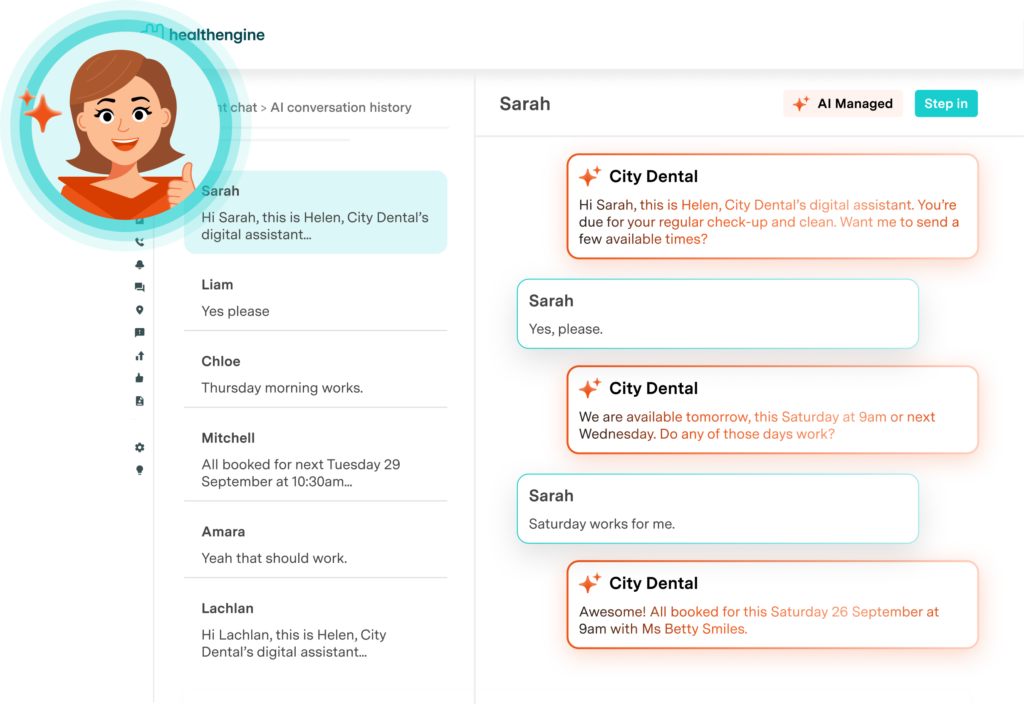
The “will AI replace (insert job title here)” narrative is far from new.
It’s almost as familiar as the answer to that question: “No, it’s a tool. It does the grunt work so you can do the high-level things.”
This might seem like a placating phrase to make you feel better about AI’s capabilities, but it’s often repeated because it’s true: think about how many times you answer the same questions about parking in a day. How many times you’ve repeated your practice hours over the phone.
AI won’t replace receptionists: nor should they. Here’s how to use an AI receptionist like Helen, as a supplement to your front desk workflow.
Let’s get one thing straight: Helen couldn’t do the part of your job that matters most
We’ll spare you the product spiel, but there are plenty of things AI receptionists can do in 2026. Features vary greatly across different AI receptionists.
AI receptionists handle the routine things, letting you take care of the complex matters like:
- Situations requiring emotional intelligence: Comforting patients after they’ve received bad news, or de-escalating angry callers.
- Exercising genuine human judgement: AI receptionists can’t detect subtleties like the caller’s breathing patterns in a medical emergency, or triage symptoms requiring an urgent appointment.
- Complex booking queries: If a patient has a complicated request and your practice has no documented way to handle these issues, or the patient has multiple names, as a few examples, these calls are transferred to the front desk immediately.
Understand the AI receptionist landscape in Australia with our free guide
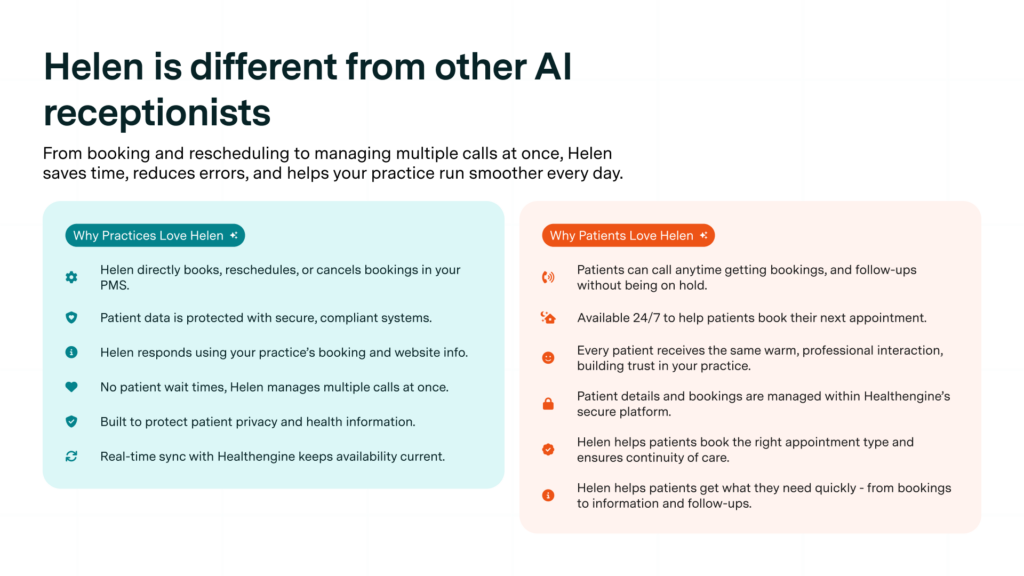
How a hybrid receptionist model does the heavy lifting
For a lot of practice managers, it’s easy to normalise the chaos of day-to-day operations.
But if this is you, here’s what you’re potentially missing: there’s a chance to have a clean slate. We know this is a big promise to make — we don’t make it lightly.
Let’s dive into some of the ways Healthengine’s AI receptionist can help free up your energy, for what you do best.
1. Smart call routing separates routine from urgent
AI receptionists don’t decide for themselves what’s within scope or not: that’s your choice.
The process of setting up an AI receptionist is a collaborative one, especially if you go with a provider that takes the time to understand your practice’s needs.
There are also certain triggers built in, which prompt an AI receptionist to escalate or transfer calls.
For Healthengine’s Helen, her smart call routing allows her to escalate calls when:
- There’s a medical emergency, in which case Helen follows strict safety protocols, transferring immediately to the front desk and instructing the patient to call 000 or go to emergency.
- A patient asks to speak to reception, with or without giving a reason depending on preferred setup.
- Instances where Helen has repeated difficulty understanding, or actioning, complex requests.
2. 24/7 answering and multiple call handling
After any public holiday, weekend, even overnight — practice managers start their day with a sea of requests to wade through.
Some AI receptionists take care of these routine tasks: answering the phone outside of your opening hours and handling multiple calls.
This means you can start each day knowing the routine aspects of bookings are taken care of — freeing up your energy for the things that truly require human empathy and judgement.
3. Booking management for existing patients
For existing patients, Healthengine’s Helen can book, cancel and reschedule appointments. First she verifies their identity by asking for their name, date of birth, and mobile number.
If the patient doesn’t have a mobile number on file, Helen transfers the call to the front desk. The same process happens if a caller is looking to make changes on behalf of others, or for multiple people.
You can configure certain settings depending on your needs: it’s worth speaking to a Customer Success Manager for more information on what Helen can and can’t do for your GP clinic.